
Extreme Risk Protection Orders
Extreme Risk Protection Orders (commonly known as ERPOs or red flag laws) empower families to get help when a loved one with access to firearms is in crisis and may pose a threat to themselves or others.
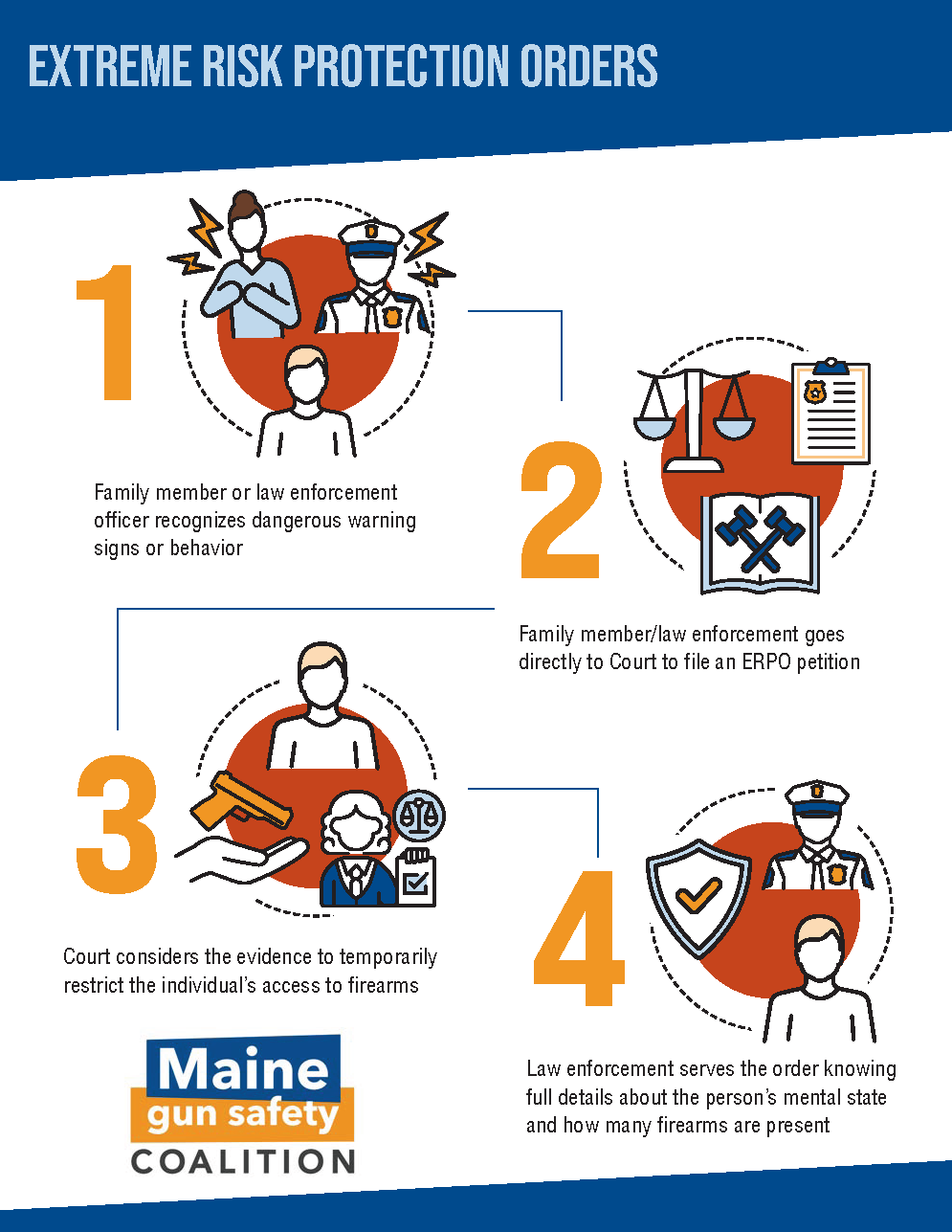
-
When family or household members recognize that a loved one is in crisis and worry that there is a significant danger of physical harm to the loved one or someone else, they can go to court to file an ERPO Petition. (Alternatively, a family can contact law enforcement, and law enforcement can file for the ERPO Petition.) This Petition must include information about the person filing the Petition (called the Petitioner) and the person who poses the danger of physical harm (called the Respondent), why the Petitioner believes the Respondent is a danger to themselves or others, and what weapons may be either accessible or in the Respondent's possession.
-
A judge will examine the evidence to determine if the Respondent poses a significant danger to themselves or others. If that is the case, the judge can issue an emergency (called “ex parte”) order to immediately remove dangerous weapons. This order is temporary until a full hearing is scheduled to ensure due process rights are protected.
If the judge determines the person does not pose an immediate danger to themselves or others, a hearing will be scheduled within two weeks at which time the Petitioner – family or law enforcement – must provide sworn evidence demonstrating that the person is a threat to themselves or others and the Respondent will be given the chance to defend these concerns.
If an ERPO is issued by the judge, law enforcement will deliver the ERPO to the Respondent within 24 hours and remove all dangerous weapons from the premises. A “final” (non emergency) ERPO lasts for up to one year, and also prohibits the Respondent from buying new weapons.
-
Law enforcement or people with specific relationships to the respondent have standing to file for an ERPO. Permissible Petitioners include:
Law enforcement;
The current or former spouse of the Respondent;
The current or former domestic partner of the Respondent;
The Respondent’s co-parent;
The Respondent’s parents;
The Respondent’s children;
The Respondent’s siblings; or
An adult currently living with the Respondent.
-
The petition must be filed in the courthouse that serves the area where the Respondent lives, or where the events that gave rise to the Petition took place. If you are unsure which courthouse serves that area, you can look it up HERE.
-
Provided that you are one of the people listed above, and you have reason to believe that there is significant danger of physical injury to the Respondents or someone else, you can go to the appropriate courthouse during business hours and ask a civil clerk for an Affidavit and Petition for Extreme Risk Protection Order (Form CWR-001). To complete this form, you will need to provide the following information:
Your name and contact information;
The Respondent’s name and contact information (to the best of your knowledge), as well as a physical description of them (to ensure the proper person is provided notice);
Your relationship to the Respondent;
Any other court orders that you personally know the Respondent is subject to;
Any dangerous weapons that the Respondent has possession of or access to; and
Why you believe the respondent is a danger to themselves or others.
You must then swear under penalty of perjury that everything you’ve provided in the Petition is true. The Petition will be sent to a judge for review. If you are worried that there is an immediate and significant danger of physical injury, you should request the emergency order.
Intentionally including any information you know to be false in the Petition is a felony, punishable by up to 5 years in prison and a fine of up to $5,000.
-
There is no cost to file an ERPO Petition.
-
No. This is a false talking point.
Due process protections require that someone has the opportunity to defend themself in court. The ERPO law provides this protection, as required by the Constitution. So the ERPO does indeed provide due process to Respondents.